Strategy · Jinn Systems
Software
Architecture
Design
The decisions that define whether a system lasts, scales, and can be understood by the next team are made in the architecture phase, before development begins.
We have designed the architecture for 20+ systems across enterprise platforms, SaaS products, real estate operations, healthcare data, and internal tools. Our software architecture design work is the foundation that makes everything that follows more predictable.
Architecture experience
- 20+ systems designed across industries
- Enterprise platforms, SaaS, real-time data, internal tools
- Architecture documented as ADRs, not verbal decisions
- All designs reviewed and signed off before sprint one
Strategy · Software Architecture Design
Why architecture matters
The decisions made in week one govern the system for years.
Every software system has an architecture, whether it was designed intentionally or accumulated through a series of unconsidered decisions. The difference between those two outcomes is not visible at launch. It becomes visible at scale, under load, or when the business changes in a direction the system was not designed to accommodate.
Architecture decisions are the hardest class of technical decisions to reverse. Choosing the wrong database model, the wrong service boundary, or the wrong API contract does not produce an error message. It produces a constraint that compounds quietly until the cost of working around it exceeds the cost of rebuilding from it.
Good system architecture design does not make software more complex. It makes it more honest. The system reflects the actual domain: the entities, the relationships, the access patterns, the concurrency model, and the failure modes. That honesty is what allows teams to extend the system rather than fight it.
Our software architecture services exist to ensure those decisions are made deliberately, with full awareness of the tradeoffs, before development begins. Not by a developer who happened to build the first prototype. By architects who have seen what the wrong decisions cost at scale.
Architecture is not a diagram
It is a set of decisions about what the system will and will not do, documented in a form that survives personnel changes.
Every decision has a cost
Including the decision not to decide. Deferred architecture choices become inherited constraints. The team two years from now will work within them.
The cheapest time to change direction
Is before development begins. After the database is populated and the API has consumers, every change carries migration risk and coordination cost.
Architecture is communication
A well-architected system is comprehensible to the developer who joins 18 months after launch. A poorly architected one is not comprehensible to the person who built it six months later.
Who we work with
Three situations where architecture is the deciding factor.
Startups scaling platforms
You have product-market fit and the system is under pressure
Growth is exposing the decisions that were made under time pressure in the early phase. Response times are increasing, deployments are becoming risky, and adding new features requires touching too many parts of the system. The architecture review clarifies what needs to change first and in what order, without stopping product development.
Enterprises building new systems
You are building something that will be load-bearing for the business
This system will process transactions, store regulated data, or orchestrate business-critical operations. The architecture is not a technical concern, it is a business risk. It needs to be designed by architects who understand what the system will carry, not just what it will do at launch.
Companies fixing broken systems
The system works but nobody can explain how
Accumulated decisions from multiple contributors over several years have produced a system that nobody fully understands. Onboarding new developers is slow. Simple changes have unpredictable consequences. A structured architecture review identifies what is load-bearing, what is legacy risk, and what the realistic migration path looks like.
Definition
What system architecture design actually involves.
Software architecture is the set of structural decisions that determine how a system is organised, how its components interact, how it handles failure, and how it can be changed. It is distinct from implementation: an architect decides what components exist and how they relate; developers decide how those components are implemented.
A good architecture is not the most sophisticated architecture. It is the architecture that fits the actual requirements: the expected load, the team size, the operational maturity, the data model, the integration surface, and the projected rate of change. Over-engineering is an architecture failure. Under-engineering is an architecture failure. The right design is the one that is appropriately sized for the real problem.
System architecture design consulting is not an abstract exercise. It produces artefacts: architecture decision records, data model documentation, API contracts, infrastructure diagrams, and deployment specifications. These are working documents that the development team uses and updates throughout the build.
The domain of architecture includes decisions that span multiple layers of a system. How data is modelled affects query patterns, affects API design, affects frontend state management, affects how the system scales. A decision made at the data layer has consequences throughout. Architects track those consequences before they become surprises.
Experienced architects also know what not to decide. Part of good architecture is identifying which decisions can be safely deferred, which abstractions create more complexity than they remove, and which patterns are appropriate for your scale and team rather than the scale and team of the company whose engineering blog you are reading.
The output of an architecture engagement is not a technology recommendation. It is a set of documented decisions with explicit rationale, reviewed tradeoffs, and a clear understanding of what the system is designed to handle and what lies outside its intended scope.
Structural decisions
Component boundaries, service responsibilities, data ownership, and the contracts between system parts.
Quality attributes
Performance targets, availability requirements, security model, maintainability, and operational characteristics.
Constraint management
Technology constraints, team constraints, budget constraints, and regulatory constraints explicitly accounted for in the design.
Evolution planning
How the system accommodates the changes that are likely to happen, not just the state it needs to reach at launch.
Scope of work
Systems we design architecture for.
Custom Software Systems
01Purpose-built systems where the data model and service structure need to reflect the specific business domain. Architecture work defines the entity model, the bounded contexts, the integration surface, and the access control model before a line of code is committed.
Web Application Platforms
02Web applications where the architecture determines how frontend state management interacts with API design, how the API layer handles authentication and authorisation, and how the backend scales under concurrent user load.
SaaS Product Architecture
03Multi-tenant SaaS platforms where the tenancy model, data isolation strategy, and subscription infrastructure need to be correct from day one. Retroactively adding multi-tenancy to a single-tenant architecture is one of the most expensive refactors in software.
Enterprise & Operations Systems
04Internal platforms, ERPs, and operational systems where the architecture must accommodate role-based access control, audit trails, workflow orchestration, and integration with other internal systems that existed before the new platform.
Technical depth
The decisions that define system architecture.
Monolith vs Microservices
This is not an ideology question. It is a team size, operational maturity, and deployment frequency question. A well-structured monolith is the right choice for most systems below a certain scale and team size. Microservices introduce coordination overhead, distributed system failure modes, and operational complexity that are only justified when the business genuinely needs independent deployment of services.
We design monoliths with clean module boundaries when that is appropriate, and distributed systems when the scale and team structure justify the cost. We also document the signals that would indicate when migration becomes necessary, so the decision to evolve is made deliberately rather than reactively.
Database Design
The data model is the most difficult architectural element to change after the system is live. Schema migrations on tables with tens of millions of rows under concurrent write load are not a routine operation. Getting the entity model, the normalisation level, the indexing strategy, and the partitioning approach right at design time is significantly cheaper than addressing them post-launch.
We design data models that reflect the actual domain, choose between relational and document storage based on access patterns rather than preference, and plan the query budget for the critical paths before the ORM is written.
API Architecture
An API is a contract. Once consumers depend on it, the cost of breaking changes is proportional to the number of consumers. API architecture decisions include the protocol (REST, GraphQL, gRPC), the versioning strategy, the authentication model, the rate limiting approach, the error contract, and the pagination pattern.
We design APIs that are consistent, predictable, and documented before implementation. The contract is agreed before the controller is written, which means consumers (including the frontend team) can develop against a specification rather than against a moving target.
Scaling Strategy
Scaling is not a switch you flip. It is a characteristic designed into the system from the start. Horizontal scaling requires stateless services, distributed session management, and idempotent operations. Vertical scaling has a ceiling. Caching strategies require cache invalidation logic designed into the data write paths.
We identify the expected load profile, the read/write ratio, the latency requirements for critical paths, and the failure modes that need to be tolerated, and then design the scaling approach appropriate to those constraints, not the most theoretically impressive one.
Architecture in practice
Systems designed. Problems solved.
Representative case studies from architecture engagements across industries. Company names are used for clarity of context.
Case 01
PropFlow
Real estate operations platform — UAE
Problem
A UAE-based real estate operations platform had grown to serve multiple property portfolios through a combination of separate databases, manual data exports, and overlapping internal tools. Each portfolio was managed in a separate system instance with its own data model. Cross-portfolio reporting required manual reconciliation. The operations team was spending significant time on data coordination rather than operations management.
Architecture approach
The architecture review identified that the fragmentation was a data model problem, not a system count problem. A centralised domain model was designed with clear entity boundaries: Property, Portfolio, Tenancy, Maintenance, and Financial Record. The data pipeline was redesigned around a unified event stream, with each operational module consuming events rather than querying each other's tables. A modular backend structure was defined so that each operational domain could be updated independently.
Outcome
Cross-portfolio reporting that previously required manual reconciliation became a first-class query against the unified data model. The event-driven pipeline reduced the coupling between modules significantly, allowing the property management and maintenance scheduling functions to be updated independently. Technical debt accumulated from the original multi-instance approach was retired systematically over four subsequent sprints, with no operational downtime.
Case 02
MediSync
Healthcare operations system
Problem
A healthcare operations system handling patient scheduling, clinical record references, and inter-facility coordination was experiencing instability under load during peak periods. Database queries that performed adequately with 500 concurrent sessions were producing timeout errors at 2,000. The team had attempted performance optimisation at the application layer without addressing the underlying structural causes. The instability was escalating in frequency as the user base grew.
Architecture approach
The architecture review identified three structural issues. First, the query patterns for the scheduling views were performing full table scans on a table that had grown to 40 million rows with no effective indexing strategy. Second, the API layer was making N+1 queries against the patient record service for each scheduling entry in a list view. Third, the session state was stored in the primary database, creating lock contention under concurrent write load. Each issue was addressed through a targeted architectural change: composite indexing on the scheduling queries, a data loader pattern for the API layer, and migration of session state to a dedicated Redis cluster.
Outcome
Peak period timeout rate dropped from 4% of requests to below 0.1% within two weeks of the structural changes being deployed. The N+1 fix reduced the query count on the scheduling list endpoint by 94%. The Redis session layer eliminated the lock contention class of errors entirely. The system subsequently handled a 3x increase in concurrent users without further architectural intervention, providing a stable foundation for the next phase of the platform's expansion.
Case 03
GridSense
Energy analytics platform — real-time data processing
Problem
An energy analytics platform was ingesting telemetry data from grid monitoring sensors at a rate of approximately 50,000 events per minute. The existing architecture was writing each event synchronously to a relational database and performing aggregations in-query at dashboard load time. As the sensor network expanded, ingestion lag was increasing to the point where "real-time" dashboards were displaying data that was 8 to 12 minutes old. The relational database was approaching storage and write-throughput limits.
Architecture approach
The architecture redesign introduced a two-tier data pipeline. An event streaming layer handled raw ingestion at volume, decoupling data receipt from data storage. A stream processing layer performed real-time aggregations as events arrived, writing pre-computed summary data to a time-series store optimised for the query patterns of the analytics dashboards. Raw event data was written asynchronously to cold storage for historical analysis. The relational database was retained for operational data only, with the query load from analytical workloads removed entirely from it.
Outcome
Dashboard data latency dropped from 8 to 12 minutes to under 15 seconds. Ingestion capacity increased to handle 5x the original sensor network volume without infrastructure scaling. The relational database, no longer carrying analytical query load, returned to normal operating latency. The time-series store architecture provides a clear scaling path to support the planned expansion of the sensor network over the next two years without architectural rework.
Our process
How an architecture engagement runs.
01
System Analysis
We review what exists: existing codebase, documentation, infrastructure configuration, deployment setup, and load data where available. We interview the team to understand what is working, what is not, and what the known constraints are.
02
Architecture Planning
We draft the target architecture: component model, data model, API contracts, infrastructure topology, and the key decisions with explicit rationale. Tradeoffs are documented rather than elided. The draft is circulated for review before it is treated as decided.
03
Design Documentation
Architecture decision records, entity relationship diagrams, sequence diagrams for critical paths, API specification drafts, and infrastructure as code outlines. Documents the team can read, challenge, and maintain.
04
Validation
The architecture is tested against the stated requirements before development begins. Load calculations, failure mode analysis, and review against non-functional requirements. Known unknowns are flagged explicitly.
05
Execution Support
We remain available during development to answer architectural questions, review implementation decisions that diverge from the design, and update documentation when circumstances require it. Architecture is not a handover document, it is a living agreement.
The UAE context
Architecture decisions in
the UAE market.
The UAE has a high concentration of businesses in real estate, logistics, fintech, and healthcare that are building or scaling digital systems. Many of these engagements involve data residency requirements, Arabic language support at the database and API level, regional payment gateway integrations, and compliance with sector-specific regulations that affect data model design.
Businesses working with a web development company in Dubai frequently encounter architecture problems that were introduced because the development team was focused on delivery speed rather than structural quality. Systems that were adequate at launch become problematic when the business scales or when regulatory requirements change. Architecture work upstream prevents the majority of these scenarios.
Companies across the UAE building ERP systems, operations platforms, and enterprise software face a common pattern: the initial vendor builds a system that works for the stated requirements, but the architecture does not support the operational growth the business experiences in the following 24 months. A structured architecture review before vendor selection, or before an internal team begins development, is the most cost-effective intervention available.
We work with UAE businesses at each of these stages: before the build, during scaling, and when existing systems need structural assessment. The approach is the same regardless of stage: understand the actual requirements, design the appropriate architecture, and document the decisions in a form the team can work from.
Headquarters
Sharjah, UAE
UTC+4 (GST)
Systems designed
20+ platforms
Across 6 industries
Architecture types
Monolith, Modular
Event-driven, Microservices
Engagement types
New & legacy systems
Review, design, migration
Next steps
From architecture to execution.
An architecture engagement produces a foundation for development, not a replacement for it. The architecture documentation, data model, and API contracts are the inputs to a development engagement where implementation decisions are made within the constraints of a considered design.
For teams that have not yet defined the product scope, a software consulting engagement is often the right precursor to architecture work. Consulting clarifies what needs to be built. Architecture defines how it should be structured. Development executes against that structure.
For products in early validation, an MVP development engagement can incorporate architecture planning so that the MVP is built on a foundation that extends to the full product, rather than one that requires replacement when validation is successful.
Consult
Define what needs to be built and why. Scope, assumptions, and constraints clarified before any architecture work begins.
Architect
Design the system structure, data model, APIs, and infrastructure. Document decisions with rationale. Review and validate before development.
Build
Development proceeds against a clear architectural brief. Faster, more predictable, with fewer structural surprises.
Software Development Company →Recent work
Systems we have shipped


Multi-Brand Group
ETS Group
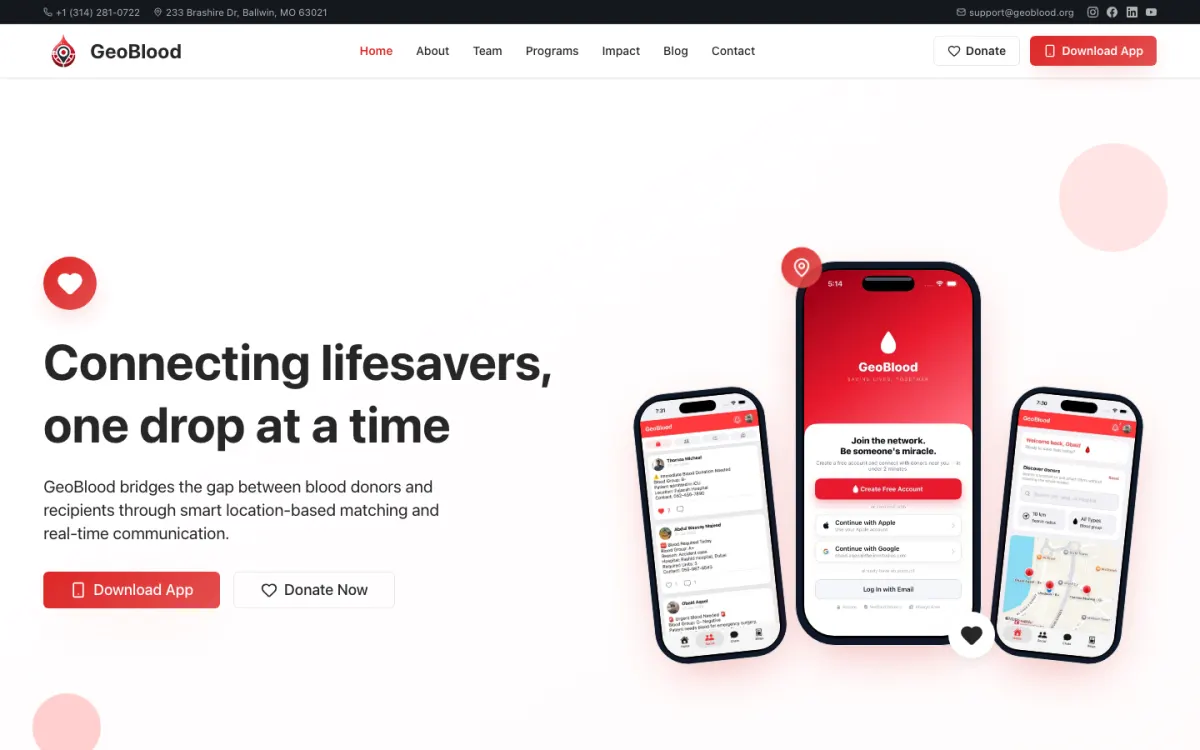

Health Platform
GeoBlood

Mobile Product
GeoBlood App


Air Monitoring
AirSentinel


Environmental Tech
BreatheIO


ICT / Security / Systems
Alebdaat


Robotics
MechaBots
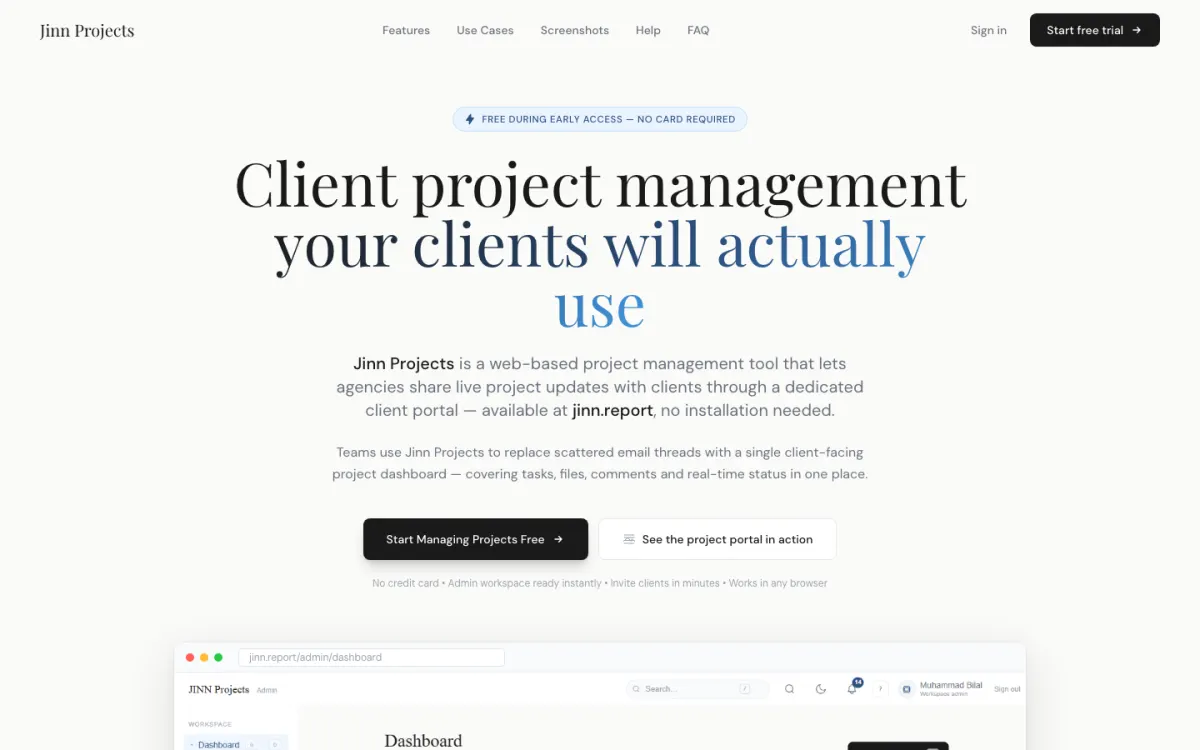

Client Project Workspace
Jinn Reports


Visual Note-Taking
Jinn Notes


Digital Business Cards
TapTag


Hosting Infrastructure
JinnHost
Open-Source Control Panel
Jinn Panel


Game Development Academy
Jinn Academy

Unreal Engine 5 Program
IGI


Luxury Commerce
SHAZ


Property
Bridgewood


Digital Legacy
Dead Man Safe


Personal Brand
Shorouk Al Abdallah


Studio
Jinn Studios


Entertainment
Cup Entertainment
Architecture review
Get the structure right
before you build on it.
Whether you are designing a new system or reviewing an existing one, an architecture engagement gives you a documented foundation, an honest assessment of the risks, and a clear path forward. No assumption made by the first developer who touched the codebase should govern the next three years of your product.
After you reach out
We respond within one business day with an initial read on the architecture challenge and a proposed format for the engagement.
Technical intake
A structured 60-minute session covering the current system state, the known issues, the business requirements, and the constraints that will shape the design.
Architecture proposal
A written proposal covering the engagement scope, the artefacts we will produce, the timeline, and the investment. No ambiguity about what you are buying.